


A mall operator in the Middle East installed a standard trampoline area with a few basketball hoops. Children jumped for 25 minutes and then wandered toward the food court. The operator replaced it with a fantasy themed indoor play equipment system. Same 100㎡ footprint, same age group, but now families stayed for 80‑90 minutes. Parents bought drinks and snacks. The operator's per‑visit spend increased by 55% within two months.
What changed? Not the trampolines alone. The fantasy theme added a narrative layer. A child entering a fantasy‑themed indoor play equipment system doesn't just jump. They enter a quest: cross the obstacle course, slide through the giant slide barrels, bounce through the fantasy trampoline zone, and explore the ball pit.
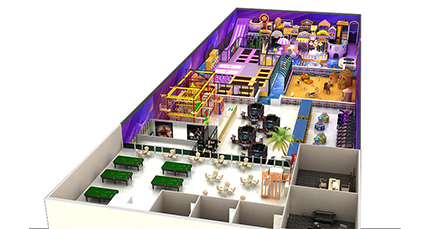
A fantasy‑themed indoor play equipment system designed for 20‑200+㎡ spaces includes a trampoline zone with high‑tension springs, an adventurous obstacle course, giant slide barrels, and sleek slides. The layout uses space efficiently, with dedicated zones for different age groups. This article explains how a fantasy theme adds 50 minutes of dwell time, why the ASTM safety certifications protect both children and the operator's liability, and where the galvanized steel frame and LLDPE plastic parts meet the demands of daily commercial use.
An indoor play equipment system without a theme is a collection of physical activities. Children cycle through trampolines, slides, and obstacle courses, then repeat. Once they've done each activity twice, they leave.
A fantasy theme adds a story. The trampoline zone becomes a magical forest clearing. The obstacle course becomes a dragon's lair. The slide barrels become enchanted tunnels. Children spend time not just playing but exploring, searching for hidden "treasures," and completing imaginary quests. For a 50‑200㎡ venue, the theme turns a 30‑40 minute visit into an 80‑90 minute visit, directly increasing concession sales and per‑cap spending.
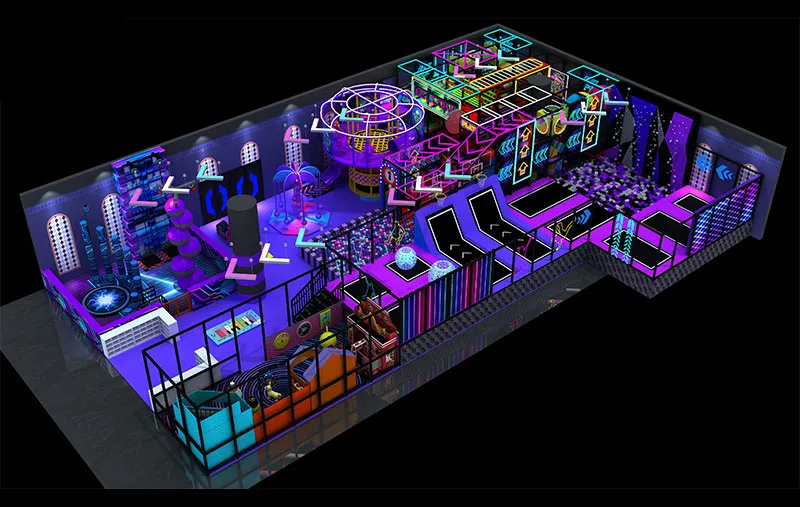
The indoor play equipment includes zones that reinforce the fantasy narrative:
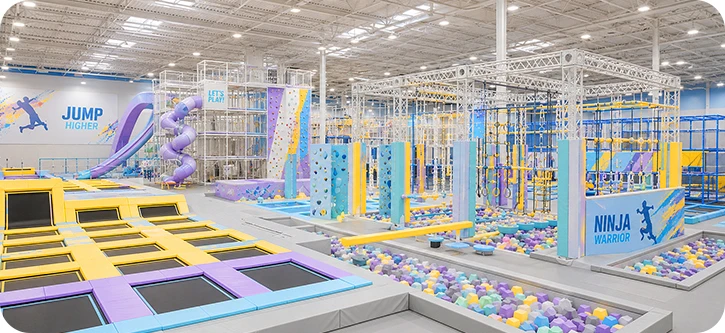
Fantasy Trampoline Zone: High‑tension springs with durable PVC padding in fantasy colors (purple, silver, blue), creating a magical bouncing surface.
Adventurous Obstacle Course: Stepping stones, balance beams, and climbing elements that simulate a journey through an enchanted forest.
Giant Slide Barrels: Enclosed spiral slides themed as magical portals or dragon tunnels.
Fantasy Ball Pit: Themed ball pit with colorful, soft balls that invite imaginative play.
The sleek slide design adds to the high‑energy fun, while the vibrant, futuristic aesthetic appeals to tech‑savvy families.
| Zone | Age Focus | Key Feature | Dwell Time Contribution |
|---|---|---|---|
| Fantasy Trampoline Zone | 4‑12 | High‑tension springs, PVC padding | 15‑20 min |
| Obstacle Course | 5‑12 | Stepping stones, balance beams | 10‑15 min |
| Giant Slide Barrels | 3‑10 | Enclosed spiral tubes | 10‑15 min |
| Fantasy Ball Pit | 3‑8 | Colorful soft balls, themed decor | 15‑20 min |
A fantasy theme triggers a different emotional response than generic bright primary colors. Parents see a fantasy world as an adventure, not a chaotic free‑for‑all. The purple, silver, and blue color palette is perceived as magical and calming compared to neon reds and yellows. For a shopping mall operator, the fantasy theme photographs well on social media — parents posting photos of their children on fantasy‑themed equipment tag the location, generating organic marketing.
An operator without safety certificates will struggle to get commercial liability insurance, or pay a premium that kills the business. An indoor play equipment system installed in a shopping mall or family entertainment center must meet ASTM standards (the American standard for playground equipment safety).
The equipment meets and exceeds global standards including ASTM in the United States. All equipment is manufactured and designed in accordance with safety standards, with regular staff training to ensure strict supervision during planning, design, production, and installation. The facility also complies with EN71 (toy safety) and UL94 (flammability) where applicable.
For a mall operator, the certification means the playground satisfies the property's liability requirements without requiring additional structural modifications. The test reports are available for each component. For a family entertainment center owner, presenting the ASTM certificates to the insurance carrier can reduce liability premiums. A non‑certified playground may not be insurable at any price.
The product specification includes an "ASTM Safe Zone" that is customized based on the equipment layout. The safe zone is the impact‑attenuating surface area required around each play element. For a trampoline, the safe zone extends 2‑2.5 meters from the edge. For a slide exit, the safe zone is the landing area. The designer incorporates these zones into the layout, ensuring compliance without wasting floor space.
A 50‑200㎡ space with proper safe zone planning can accommodate 25‑80 children simultaneously. The capacity ranges are:
| Space Size | Recommended Capacity | Age Range |
|---|---|---|
| 20‑50 sqm | 15‑30 children | 3‑12 years |
| 50‑100 sqm | 25‑50 children | 3‑12 years |
| 100‑200 sqm | 40‑80 children | 3‑12 years |
| More than 200 sqm | 80‑200 children | 3‑12 years |
Data sourced from product specifications.
The recommended age range is 3‑12 years old, covering preschool through early adolescence. For children under 3, the equipment is not designed for their physical capabilities, and operators should provide a separate toddler area.
An indoor play equipment system in a commercial venue sees 100‑200 children per day. The material specs must support commercial‑grade durability.
The fantasy‑themed equipment is built with:
High‑tension springs: Durable springs that maintain consistent bounce performance over thousands of jumps.
Durable PVC padding: Thick padding covering springs and frame edges, absorbing impacts and preventing injuries.
Anti‑slip surfaces: Jumping mat and platform surfaces designed to prevent slips even when children are running.
LLDPE plastic parts: Linear low‑density polyethylene used for slides and other plastic components, offering high impact resistance.
Fiberglass reinforcements: Used in structural plastic elements for added strength.
Galvanized steel pipe: National standard galvanized steel pipe for posts, providing corrosion resistance and structural rigidity.
Deck, stair, bridge construction: Wood core with sponge, rubber, or powder coating, balancing strength and softness.
Soft Covering PVC: Outer cover material that is water‑ and oil‑proof, easy to clean, and flame‑retardant.
The trampoline park is built with cutting‑edge materials, including high‑tension springs, durable PVC padding, and anti‑slip surfaces for maximum safety. The sleek slides add to the high‑energy fun, perfect for tech‑savvy families.
Galvanized steel pipe undergoes a zinc coating process that creates a protective barrier against corrosion. In an indoor environment with humidity from children's activity and occasional cleaning, uncoated steel would show rust within 12‑18 months. The galvanized coating provides a corrosion rate 1/30 that of bare steel. The production process includes 11 stages: cutting, welding, polishing, sand blasting, powder coating, drying, packing, injection‑molding, refinement, polishing, and final packing. The sand blasting step removes weld slag and mill scale before powder coating, ensuring adhesion. Powder coating adds a second corrosion barrier and provides the vibrant fantasy colors (purple, silver, blue).
The steel components are primed at welded areas and coated with powder coat to protect from fading and rust. The result is an 8‑15 year lifespan with proper maintenance.
LLDPE (linear low‑density polyethylene) is rotomolded for slides and tube elements. The material has high strength and weather resistance, maintaining impact strength across the full operating temperature range of an air‑conditioned mall. The plastic parts are UV‑resistant (anti‑UV), anti‑static, and color‑fast (does not fade easily), with environmental protection (non‑toxic) properties. For a slide that sees 200 children per day, the LLDPE surface will not crack, craze, or become brittle for 5‑8 years.
The plastic parts are injection‑molded for precision and consistency, ensuring that slide sections fit together without sharp seams that could catch clothing or skin.
An indoor play equipment system for a 30㎡ KFC corner cannot use the same layout as a 300㎡ shopping mall installation. The design must scale.
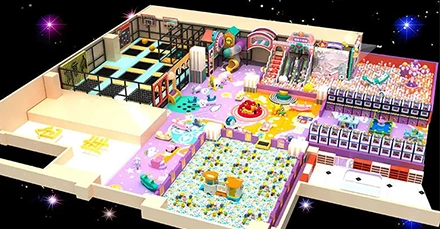
The fantasy‑themed equipment is offered in customizable layouts from 20㎡ to 200+㎡. A 30㎡ mini version might include only a compact trampoline zone, a small slide, and a ball pit, suitable for a fast‑food restaurant play area. A 200+㎡ full adventure zone includes all zones: trampoline zone, obstacle course, giant slide barrels, ball pits, and climbing structures.
The equipment is suitable for a wide range of venues including shopping malls, KFC, fitness centers, coffee houses, toy stores, furniture or automotive stores, laundry shops, kindergartens, amusement parks, indoor themed parks, game centers, and pre‑schools.
For a fast‑food restaurant with limited space, a 30‑50㎡ layout focuses on the trampoline zone and small slide, keeping children active within view of parents seated at nearby tables. For a shopping mall with 150㎡ available, the design includes multiple levels and separate zones for different age groups. The designer works around columns — turning a structural column into part of the fantasy theme with themed wraps or using it as an anchor point for suspended elements.
Free designs are provided as long as the customer gives the floor space dimensions. The design team customizes each layout to the exact floor plan, working from architectural drawings. The CAD instruction and assembly procedure ensure accurate installation.
The capacity table lists recommended occupant load based on square footage:
20‑50 sqm: 15‑30 children
50‑100 sqm: 25‑50 children
100‑200 sqm: 40‑80 children
More than 200 sqm: 80‑200 children
These numbers align with local fire code requirements for occupant load. Exceeding these capacities creates supervision gaps and may violate fire code. The operator should use these figures as maximums, not daily targets.
The manufacturing process for indoor play equipment includes 11 stages: cutting, welding, polishing, sand blasting, powder coating, drying, packing, injection‑molding, refinement, polishing, and final packing. This multi‑stage process eliminates hidden defects.
Cutting: Steel pipes are cut to precise lengths. Welding: Components are welded with full‑penetration welds. Polishing: Weld seams are smoothed to remove sharp edges. Sand Blasting: Weld slag and mill scale are removed, creating a surface profile for powder coating adhesion. Powder Coating: Color coating is applied (purple, silver, blue for fantasy theme) and baked on. Drying: Coated parts are dried in a controlled oven. Packing: Parts are packed for shipping. Injection‑molding: Plastic components are molded to precise tolerances. Refinement: Plastic edges are trimmed. Polishing: Final smoothing of all exposed surfaces. Packing: Final packing for export.
The inventory parts are carefully checked before assembly, including brackets, connectors, plastic parts, safety nets, and air cushions. The galvanized pipe frame is fixed with iron passes, and the installation sequence is: first assemble the naughty castle products that can be up and down, then assemble plastic and wood products, finally weave the protection net, wrap the protection sponge tube, and place the sky platform.
Each net hole needs to be fixed with 4 small buckles (¢32), and larger buckles (¢114) are used for key attachment points. The fixing method of different parts and the type of screws are specified in the instruction manual.
The pre‑installation site check ensures the site is level, free of sharp objects and debris, and that the size and shape are suitable for the installation of the equipment.
After installation, the equipment must be inspected for potential hazards. A Certified Playground Safety Inspector should verify that every bolt is tight, every anchor is properly secured, and every fastener is tamper‑proof. The installation manual provides detailed drawings and layout instructions for the particular job site.
Common post‑installation issues include: loose bolts from under‑torquing, safety netting that is not tensioned properly, and padding that leaves a gap where a child could pinch fingers. A professional installer checks these items before handing over the equipment.
The equipment is designed to engage children in multiple types of movement that stimulate development across several domains. The primary functions are climb, jump, crawl, run, throw activities.
Climbing: The obstacle course and climbing elements develop gross motor skills, upper body strength, and coordination. Jumping: The trampoline zone builds leg strength, balance, and cardiovascular endurance. Crawling: Tunnels and low passages develop proprioception (body awareness) and spatial reasoning. Running: Open zones encourage cardiovascular activity and social play. Throwing activities: The ball pit and interactive elements develop hand‑eye coordination and fine motor control.
These activities can stimulate children's curiosity, exploring desire, and build up their consciousness of team work and their abilities of cognition, judgment and problem‑solving. For parents, this is a significant selling point — they are not just occupying their children; they are contributing to their development.
The equipment also encourages social interaction. The obstacle course and trampoline zone are designed for multiple children simultaneously, fostering turn‑taking and cooperative play. The fantasy theme provides a shared narrative framework that encourages children to play together rather than in isolation.
Ningke Playground (Ningke Amusement Equipment Co., Ltd.) manufactures the fantasy theme indoor play equipment as a complete modular system for 20‑200+㎡ venues. The equipment includes a trampoline zone with high‑tension springs, an adventurous obstacle course, giant slide barrels, ball pits, and sleek slides. Material specifications are galvanized steel pipe (national standard), LLDPE plastic parts, fiberglass reinforcements, wood core decks with soft covering, and durable PVC padding with anti‑slip surfaces. The equipment meets ASTM safety standards and carries CE certification. The 11‑stage production process includes cutting, welding, polishing, sand blasting, powder coating, and injection‑molding. Professional installation is available, with CAD instructions for remote assembly. Free design layouts are provided based on customer floor space.
An indoor play equipment system that tells a story — where bouncing on a trampoline becomes a magical journey, crossing an obstacle course becomes evading a dragon, and sliding through a barrel becomes traveling through an enchanted tunnel — keeps children engaged for nearly three times as long as a basic bounce floor. For a family entertainment center operator who wants to maximize per‑cap spending and reduce churn, the fantasy‑themed indoor play equipment delivers the narrative, safety certifications, and material durability that turn a 20‑200+㎡ space into a destination.
【Request a quote from Ningke Playground】
Send Ningke your floor space (20‑200+㎡), target age range (3‑12 years), and preferred fantasy theme to receive a custom layout, equipment list, and certification package for fantasy‑themed indoor play equipment.
 15+ years crafting play
 SGS | EN1176 | ASTM
 40+ countries


 English
 Español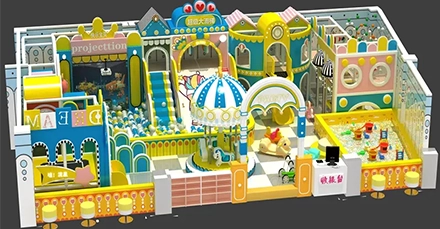
-1507.webp)
.jpg)
.jpg)
.jpg)