


A trampoline park operator in Ningbo ran two free‑jump courts and a dodgeball court seven days a week. After 18 months, the frames near the dismount zone began to sag. The original frames were 2.0mm steel. The steel bent under repeated adult jumpers, mat tension dropped, and the park risked a fall. Instead of replacing the entire court, the operator upgraded the frame to 3.0mm hot‑galvanized Q235 steel, restoring bounce tension without buying new mats.
An indoor play equipment system has a hidden structural hierarchy. Steel thickness, spring density, padding depth, and the factory’s welding process determine whether a court lasts five years or fails within two. Ningke’s BC‑C‑002 Indoor Commercial Trampoline Park Equipment uses frame steel from 2.0mm to 3.0mm wall thickness, hot‑dip galvanized to resist rust. The jumping mats are high‑elastic PP with reinforced stitching and non‑slip coating. Padding is 40mm high‑density foam covered with waterproof PVC leather. This article explains how frame thickness and spring tension affect maintenance cycles, why the 11‑stage factory process reduces hidden defects, and how CE and ASTM F2970 certification helps lower insurance premiums.
The primary structural element of a commercial trampoline court is Q235 hot‑dip galvanized steel pipe. Frame specifications range from 40mm × 40mm posts up to 100mm × 100mm main beams. For a 150m² park, Ningke supplies main frames with wall thickness between 2.0mm and 3.0mm. The 2.0mm spec works for children‑only facilities with low daily throughput. For parks that serve both adults and kids on the same court, 3.0mm wall prevents “beam sag” that creates low spots in the mat surface, which can increase ankle injury risk.
Ningke’s manufacturing process has 11 stages: cutting, welding, polishing, sand blasting, powder coating, drying, packing, trampoline mat sewing, foam cutting, padding cover sewing, and padding packing. Sand blasting removes weld slag and mill scale before powder coating, ensuring adhesion. Powder coating adds a second corrosion barrier, but the foundation is hot‑dip galvanizing (≥2.5mm steel thickness) that provides sacrificial protection even if scratched.
An 85kg adult jumping on a free‑jump court applies roughly 250‑300kg momentary load per landing. Thinner steel flexes more with each landing, work‑hardens, and eventually a crack propagates near a weld seam. A 3.0mm wall reduces flex per landing, extending fatigue life. The difference between 2.0mm and 3.0mm steel in a high‑traffic park can be 2‑3 years of service life. For the Ningbo operator, upgrading the frame added about 12% to the initial equipment cost but postponed replacement by two years.
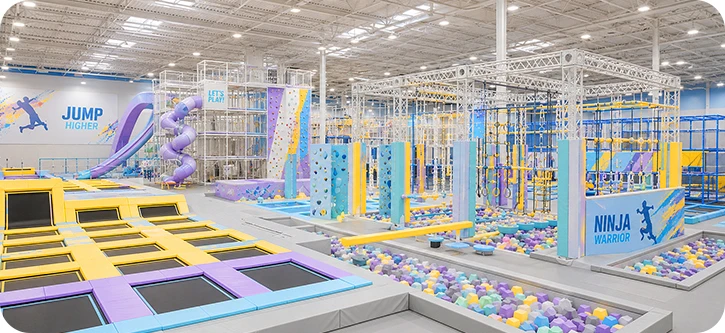
The spring system provides the bounce. Spring wire diameter, coil pitch, and unloaded length determine the mat’s response curve. A “child‑friendly” court uses lower‑tension springs, producing a smaller bounce for light children. A “mixed‑use” court uses a balanced spring stiff enough for adults yet responsive for children.
Commercial courts typically use 180‑220 springs per standard 4.2m × 4.2m bed. Tighter spring packing distributes load more evenly, reducing stress on individual springs and extending replacement intervals.
| Frame & Spring Parameter | Entry‑Level | Commercial Grade (Ningke) |
|---|---|---|
| Steel wall thickness | 1.8‑2.0mm | 2.5‑3.0mm hot‑galvanized |
| Spring count per bed (4.2m) | 130‑160 | 180‑220 |
| Spring material | Standard carbon steel | Cold‑coil galvanized |
| Spring cover | Optional or none | Full PVC spring cover included |
| Estimated frame life (mixed‑use) | 2‑3 years | 5‑8 years |
Ningke’s BC‑C‑002 specification includes cold‑coil galvanized springs with PVC spring covers. The spring cover protects children’s fingers from pinch points and prevents debris accumulation.
A trampoline court has three key soft components: the jumping mat, the edge padding, and the protective netting. Low‑quality materials lose performance quickly. Ningke’s production sequence is designed to eliminate hidden defects through multi‑stage quality control.
The jumping mat is woven from high‑elastic polypropylene (PP) with double‑stitched seams. The material resists stretching under repeated load and is treated with UV inhibitors. In a high‑usage commercial park, a mat may last 2‑3 years before seam fraying appears. The mat’s non‑slip coating is applied during weaving, not as an aftermarket spray.
Edge padding consists of 40mm high‑density foam wrapped in 0.45mm PVC leather. The foam provides impact absorption that prevents bruising from edge landings. The PVC cover is water‑ and oil‑proof, easy to wipe down after daily sanitization.
Ningke’s 11‑stage process includes two foam‑specific steps: Foam Cutting For Padding and Padding Cover Sewing. These occur after powder coating but before final packing, ensuring foam density and PVC thickness are traceable to a single quality system.
Protective netting is high‑density polyethylene mesh sized to EN1176 specifications to prevent head entrapment. The netting is UV‑stabilized to prevent brittleness after years of exposure to mall lighting and skylights.
The 5‑7% annual maintenance budget that operators allocate for springs, mats, and frame coating is directly affected by the factory’s internal quality control. Ningke uses multi‑stage inspection from raw material to final product, covering cutting precision, welding seam integrity, powder coating thickness, foam density, and stitching.
Routine inspections of mat seams, padding cover tears, and spring conditions are included in Ningke’s after‑sales support plan. Operators can request spare parts (springs, foam blocks, PVC patches) directly from Ningke’s parts inventory. After‑sales maintenance services, technical support, and spare parts availability are all part of the one‑stop package. A park operator who refreshes springs every 16‑18 months and inspects seams monthly can keep equipment performance near factory levels for 5‑7 years.
An operator without safety certificates will be unable to secure commercial liability insurance, or the insurance premium will be too high. Ningke equipment meets CE marking (EU conformity for machinery and low‑voltage electrical components), EN1176 (European playground safety standard covering structural integrity, entrapment hazards, fall zones), and ASTM F2970 (American standard for design, manufacture, installation, operation, maintenance, inspection, and major modification of commercial trampoline courts).
Presenting EN1176 and ASTM F2970 certificates to an insurance carrier can reduce liability premiums. A non‑certified park may not be insurable at any price. The certificate documents also include load testing reports for the frame and fall height calculations for foam pits.
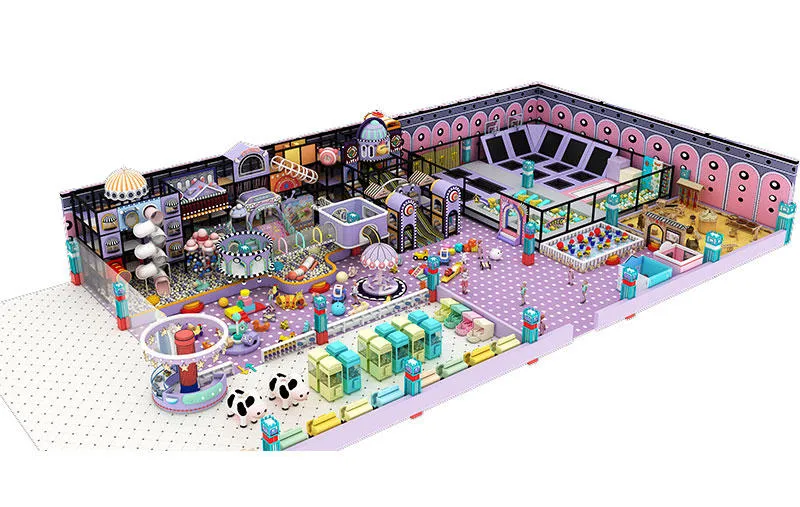
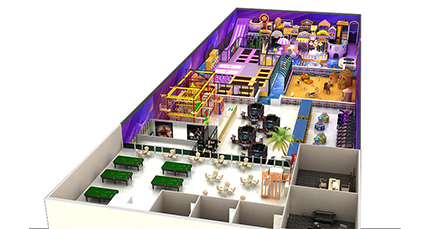
A rectangular 150m² space is easy for any supplier. An L‑shaped 220m² bay with a load‑bearing column in the corner is a different problem. Ningke’s design team customizes each BC‑C‑002 layout to the exact floor plan, routing the free‑jump court around the column and installing climbing nets around it, turning the column into a play feature.
The BC‑C‑002 can be scaled from a small 100‑200m² community park (using compact layouts) up to 1500‑2000m² family entertainment centers (adding zip lines, ninja courses, and partitioned foam pits). Ningke’s capacity reaches millions of units annually, enabling rapid turnaround for large projects.
Ningke Playground (Ningke Amusement Equipment Co., Ltd.) manufactures the BC‑C‑002 as a customizable commercial trampoline platform for 100‑1500m² venues. The equipment uses steel frame thickness from 2.0mm to 3.0mm, high‑elastic PP jumping mats with spring covers, 40mm high‑density foam padding wrapped in 0.45mm PVC leather, CE and ASTM F2970 certification with test reports, and 11‑stage in‑house production covering cutting, welding, polishing, sand blasting, powder coating, mat sewing, foam cutting, and padding cover sewing. After‑sales services include regular maintenance, technical support, and spare parts availability through a dedicated team.
For an indoor play equipment system that turns a 180m² retail bay into a profitable 14‑month payback, Ningke’s BC‑C‑002 delivers the structural steel, spring density, padding specifications, safety certifications, and custom layout planning that an experienced operator requires.
【Request a quote from Ningke Playground】
Send your floor plan (PDF or CAD) and target daily capacity to Ningke for a BC‑C‑002 layout drawing, material spec sheet, and certification package.
 15+ years crafting play
 SGS | EN1176 | ASTM
 40+ countries


 English
 Español
-1507.webp)
.jpg)
.jpg)
.jpg)