


You've got a space. Maybe it's a section of a shopping mall that's been vacant since the last tenant moved out. Maybe it's an old warehouse you're converting into a family entertainment center. Maybe it's a sports complex with extra square footage you don't know what to do with.
A trampoline park seems like an obvious answer—high energy, high traffic, high revenue. But not every space is suited for this type of attraction. This guide walks you through the critical factors that determine whether a trampoline park is the right fit for your venue—and how to avoid the costly mistake of installing a park in a space that can't support it.
Before you talk to any equipment supplier, walk through your space with these three criteria in mind.
The single most common reason a venue can't host a trampoline park is ceiling height. A main trampoline court needs a minimum of 5.5 meters of clear height. That's not negotiable. Lower ceilings create safety risks—jumpers can hit overhead structures—and limit the attractions you can install. Angled walls, aerial features, and basketball hoops all need vertical clearance.
If your ceiling is under 5 meters, a trampoline park isn't the right fit. Consider other attractions: soft play, climbing structures, or interactive games.
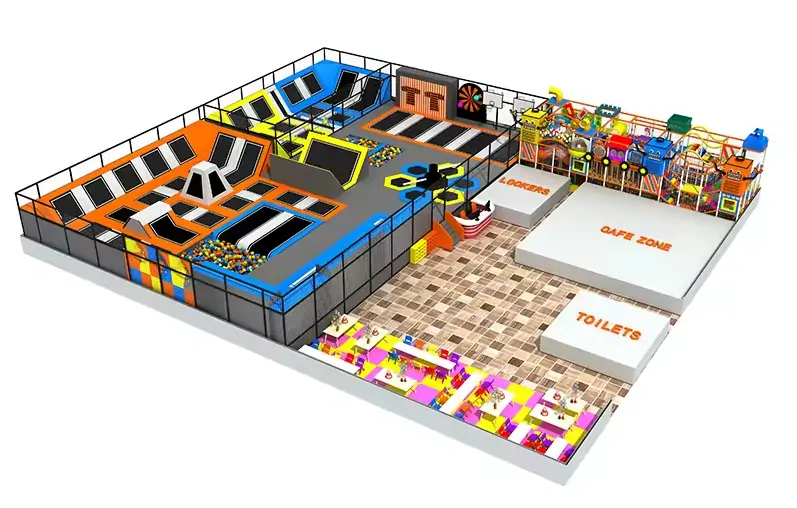
Trampoline parks range from small facilities (100–200m²) to flagship locations (1,000m²+). The size of your venue determines the attraction mix:
100–300m²: Single jump court, basic foam pit, limited capacity
300–600m²: Multiple jump lanes, angled walls, dodgeball area, spectator seating
600–1,500m²+: Full court with all attractions, party rooms, café area
Smaller spaces can still work—they just require a more focused layout and careful equipment selection.
Trampoline parks are heavy. The steel frames, jump mats, and padding add up. The floor must support the weight of the structure plus the dynamic loads of jumpers landing repeatedly. Check with a structural engineer to verify that your floor can handle the load.
Columns in the middle of the space are problematic. They create obstructions that break up the flow of the park. A design team can work around columns, but they reduce usable square footage.
Below is a quick reference table for venue suitability:
| Requirement | Minimum | Ideal | Why It Matters |
|---|---|---|---|
| Ceiling height | 5.5m | 6.5m+ | Safety for jumpers; allows angled walls |
| Floor area | 100m² | 300m²+ | More area = more attractions = higher revenue |
| Column-free span | N/A | Preferred | Columns break up layout and reduce usable space |
| Floor load capacity | Consult engineer | Heavy-duty | Dynamic loading from jumpers |
| Access | Ground floor preferred | N/A | Easy equipment delivery and customer access |
Different venues need different approaches to trampoline park design.
Malls typically have the right ceiling height—often 5.5–6.5 meters—and plenty of floor space. The challenge is column placement and access. A mall-based trampoline park should also include a retail component: socks, branded merchandise, or birthday party packages that give people a reason to stay and spend.
Sports complexes already have foot traffic—athletes, parents, and spectators. A trampoline park adds a new revenue stream that brings in families who aren't there for team sports. It also adds value for existing customers: kids can play while their siblings are at practice.
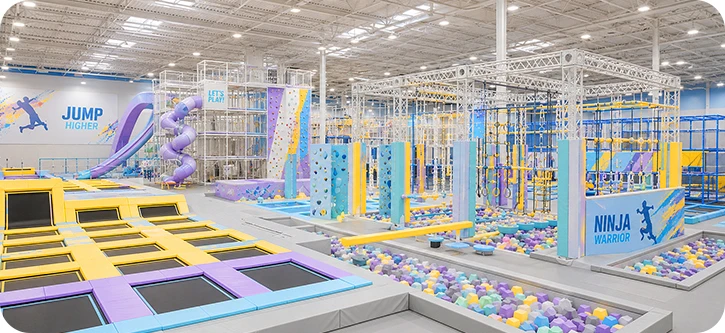
Warehouses offer the most flexibility—high ceilings, open floor plans, and large footprints. The challenge is often cost: converting a raw warehouse requires HVAC, flooring, lighting, and restroom upgrades. But the end result is a flagship trampoline park that can support a full attraction mix.
Once you've confirmed your space can support a trampoline park, the next question is what equipment you need—and how to know it's built to last.
Commercial trampoline frames need 2.0mm to 3.0mm wall thickness in the steel. Thinner steel flexes under the repetitive loading of jumpers and can develop stress fractures over time. Hot-dip galvanizing prevents corrosion, extending frame life to 10 years or more.
The components that jumpers actually touch take the most abuse. Commercial-grade jump mats use high-strength PP with non-slip surfaces. Springs must maintain tension through thousands of bounce cycles. Padding needs to be thick enough (40mm+) to absorb impact and covered with durable, easy-to-clean material.
Ningke's trampoline park equipment is ASTM F1918 and EN1176 certified. These standards cover structural integrity, materials, installation procedures, and maintenance requirements. For an operator, certification isn't just about compliance—it's about liability protection.
Q: What's the minimum ceiling height for a trampoline park?
A: The absolute minimum is 5.5 meters for a standard jump court. Angled walls, aerial features, and basketball hoops need 6.5 meters or more. If your ceiling is under 5 meters, a trampoline park isn't viable—explore other attractions like soft play, ninja courses, or climbing structures.
Q: How much space do I need for a profitable park?
A: The smallest viable trampoline park is around 100m². At that size, you're limited to a single jump court and basic foam pit. For a park with attractions that support multiple revenue streams—dodgeball, angled walls, party rooms—plan for at least 300–600m². Larger parks (1,000m²+) support the highest revenue but require correspondingly larger capital investment.
Q: Can a trampoline park be installed in a space with columns?
A: Yes, but columns reduce usable square footage and require careful design planning. The design team will work around columns by positioning them between courts or incorporating them into the layout. A column-free space is always preferable.
Q: What certifications should the equipment have?
A: Look for ASTM F1918 (the standard for soft contained play equipment) and EN1176 (European playground equipment standard). CE certification is also important for equipment sold in European markets. Ningke's equipment meets both ASTM and EN1176 standards.
If your space passes the height, area, and structural tests, Ningke Playground can help you turn it into a revenue-generating trampoline park. The company's BC-C-002 indoor commercial trampoline park equipment uses 2.0mm to 3.0mm galvanized steel frames, high-elastic springs, non-slip PP mats, and 40mm foam padding.
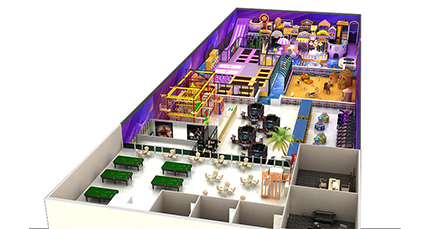
Ningke's equipment is customizable for venues from 100 to 1,500m². The design team starts with a site assessment—measuring your actual space, noting column locations, and identifying any constraints—then develops a 3D layout that maximizes usable area. The modular design allows for future expansion as your business grows.
With million-unit annual production capacity from their large-scale factory, Ningke delivers equipment that meets ASTM and EN1176 standards with CE certification. The company's product series covers playgrounds, trampoline parks, and soft play, serving kindergartens, schools, community parks, resorts, and FECs worldwide.
Before you commit to a trampoline park investment, run through the checklist in this guide. Measure your ceiling height. Calculate your floor area. Identify any structural constraints. Then contact Ningke with your space specifications—their design team can tell you whether a trampoline park fits your venue and what configuration would work best.
Ready to find out if your space is right for a trampoline park? Contact Ningke Playground for a site assessment and customized design proposal. Share your available space, ceiling height, and column layout—their team can recommend the right configuration and equipment mix for your specific venue.
 15+ years crafting play
 SGS | EN1176 | ASTM
 40+ countries


 English
 Español
-1507.webp)
.jpg)
.jpg)
.jpg)