


A trampoline park operator looks at the bottom line after the first year. Equipment payments are fixed, but maintenance costs are climbing. A mat tore, a spring broke, and the weekly cleaning bill keeps rising. The operator realizes that the initial purchase decision—focused only on price—did not account for longevity or safety.
An Indoor Play Equipment investment for a trampoline park is not just about the price per square foot. The real costs emerge over time: replacing worn mats, repairing frames, cleaning padded surfaces, and managing liability. The difference between equipment that lasts a decade and equipment that becomes a maintenance burden comes down to three factors: safety certification, modular design, and a disciplined maintenance schedule. This guide covers what to look for when buying trampoline park equipment, how to interpret ASTM and EN1176 certifications, and the daily, weekly, and quarterly routines that protect your investment.
Safety standards are not optional for commercial trampoline parks. They are the foundation of your liability protection.
This is the standard practice for the design, manufacture, installation, operation, maintenance, inspection, and major modification of commercial trampoline courts. It covers everything from frame strength to spring tension to padding thickness. An ASTM-certified trampoline park has documented evidence that the equipment meets specific engineering requirements.
This is the European standard for playground equipment and surfacing. It covers structural strength, entrapment hazards, pinch points, and impact attenuation. Equipment certified under EN1176 undergoes rigorous testing to ensure it can withstand dynamic loads from jumping, climbing, and other activities.
A reputable manufacturer will provide certification documentation. Do not accept verbal claims. Request the test reports or the certificate number and verify it with the certifying body. Look for equipment that meets both ASTM and EN1176 standards if you operate in multiple markets or want the highest level of safety assurance. Ningke holds SGS, EN, ASTM, ISO, CE, and other certifications, providing documented safety compliance for their indoor play equipment.
A trampoline park that cannot adapt to changing trends is a park that loses customers. Modular design is the difference between a fixed layout and a flexible attraction.
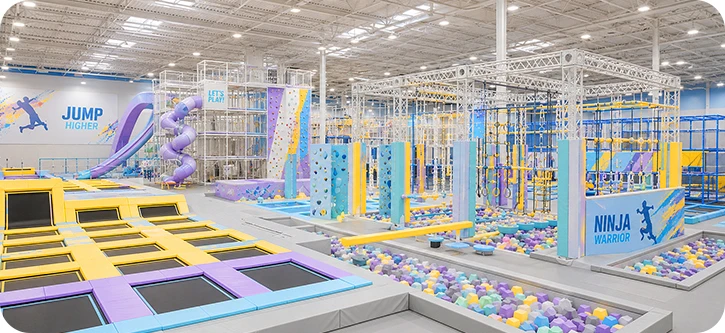
Modular equipment uses standardized components that can be reconfigured as new attractions emerge. Through modular design of a 3.0mm industrial-grade hot-dip galvanized steel frame and high-precision CAD, the utilization rate of venue space can be increased by 25%, while subsequent maintenance costs can be reduced by 30%. A park that started with only free-jump trampolines can add a dodgeball court, a foam pit, or a ninja course without replacing the entire infrastructure.
Commercial trampoline equipment is built to handle repeated, high-impact use. Load capacities typically range from 300 kg (base) to 450 kg (advanced) to 600 kg (pro) per jumping zone. For comparison, standard residential trampolines are rated for much lower weights. A commercial-grade trampoline mat must support groups of children jumping simultaneously.
Trampoline park systems are typically modular in design, allowing for scalable deployment based on available space and intended usage. Standard technical specifications for trampoline park installations include a maximum user weight capacity ranging between 100 kg and 120 kg per jumping zone. Space requirements vary: a small park typically requires at least 500 to 1,000 square meters, while medium to large parks may need 2,000 to 4,000 square meters or more.
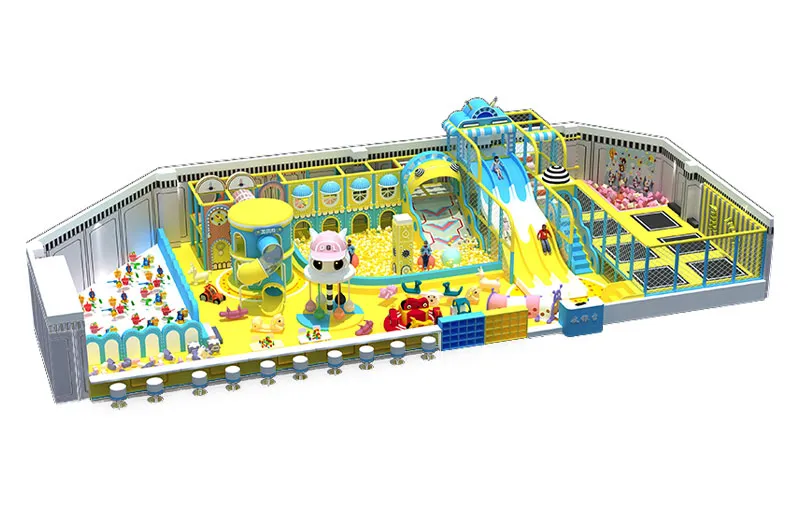
All metal parts should be made of galvanized steel pipes. Common diameters include 60mm, 48mm, 38mm, 32mm, 28mm, with wall thickness of 2.2mm. For higher durability, some manufacturers use 3.0mm industrial-grade hot-dip galvanized steel, which resists corrosion and structural fatigue. Frames should be hot-dip galvanized, not just painted—paint scratches and exposes raw metal to rust.
Jump mats are the most heavily used component. High-quality mats are made from imported materials with reinforced stitching. Some manufacturers offer a two-year warranty on jump mat stitching. Mats should be inspected daily for loose threads, tears, or stretched fabric.
Foam pits should use high-density foam blocks that retain their shape under repeated impact. Wall padding and edge padding must be thick enough to prevent injury and secured so they cannot shift. Look for padding that is easy to remove and clean—zippered covers are a sign of thoughtful design.
A trampoline park operates every day. Maintenance must be daily.
Before opening each day, walk the entire park. Check for debris, loose fasteners, torn mats, or damaged padding. A responsible individual should conduct a brief visual check for structural defects, signs of vandalism, and litter or foreign matter. Spot-clean visible dirt and stains on high-touch surfaces. Vacuum the jumping surfaces to remove dirt and small debris that could cause slipping.
Conduct a deeper inspection of structural elements. Check all fasteners for tightness—vibration from jumping loosens bolts over time. Inspect nets, enclosure systems, and any moving parts. Wipe plastic and metal surfaces with a soft cloth and neutral cleaner (pH 6–8). Avoid harsh chemicals, strong acids/alkalis, and abrasive tools like steel wool.
Inspect stainless-steel frames, galvanized tubes, LLDPE plastic components, safety nets, trampoline springs, and impact-absorbing mats. Look for cracks, rust, or deformation. Tighten any loose fasteners. Check spring tension; replace any spring that has lost elasticity.
Engage a certified playground safety inspector or follow the manufacturer’s recommended deep maintenance schedule. ASTM F2970 requires documented maintenance and inspection records for trampoline courts. These records protect you in the event of an accident—they show that you maintained the equipment to the required standard.
Q: What is the expected lifespan of commercial trampoline park equipment?
A: High-quality steel frames can last 10+ years, while soft goods like pads and mats typically need replacement every 3–5 years depending on traffic. Springs should be inspected monthly and replaced when they show signs of fatigue or rust. Some manufacturers offer a five-year warranty on galvanized steel frames and two years on jump mats.
Q: How do I choose between a standard trampoline layout and a custom design?
A: Standard layouts are cheaper upfront but may not maximize your specific space. Custom design, using modular systems, can increase space utilization by up to 25% and reduce long-term maintenance costs by 30%. A smart custom design anticipates future growth, allowing you to add new attractions without major reconstruction.
Q: What certifications should I absolutely require from a manufacturer?
A: At minimum, require ASTM F2970 for the US market or EN1176 for the European market. CE marking is also mandatory for equipment sold in Europe. Some manufacturers also hold TUV or SGS certifications, which provide third-party validation of quality and safety.
Q: How much does a trampoline park cost to equip?
A: Equipment costs typically consume 30–50% of total startup costs for a trampoline park. A small park (2,000–3,000 sq ft) requires a different budget than a large park (5,000+ sq ft). Beyond equipment, factor in installation, safety surfacing, and ongoing maintenance. The modular design approach allows you to phase your investment—start with core attractions and add more as revenue grows.
Q: Can the same equipment be reconfigured if I want to change attractions later?
A: Yes, if you purchase modular equipment. Modular grid systems allow you to reconfigure the layout as market trends change. A dodgeball court can become a parkour zone; a foam pit can be relocated. This flexibility extends the useful life of your equipment investment.
The trampoline park industry evolves. What is popular today—dodgeball and foam pits—may be replaced by ninja courses and climbing walls tomorrow. A fixed layout cannot adapt; a modular layout can.
With modular equipment, you can open with a smaller, profitable layout and reinvest revenue to expand. This reduces upfront capital requirements and lowers risk. A modular design can also be reconfigured without purchasing entirely new equipment.
Standardized components mean replacement parts are readily available. A broken frame section can be swapped without replacing an entire zone. A worn mat can be replaced individually rather than as a set. The modular design approach also simplifies cleaning—components can be removed and sanitized separately.
A park that adds new attractions annually keeps customers coming back. Modular design makes it feasible to refresh the layout without closing for weeks.
When a trampoline park operator needs equipment that balances safety, durability, and flexibility, the manufacturer’s engineering and service capabilities matter. Ningke specializes in indoor play equipment, including trampoline parks, ninja courses, naughty castles, and soft play structures. Their product series covers playgrounds, trampoline parks, baby safety fences, and other indoor attractions.
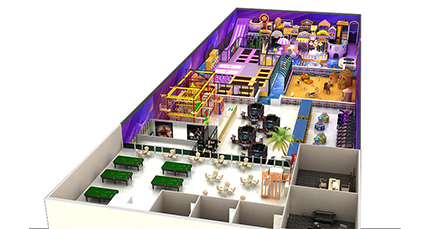
Ningke‘s equipment complies with SGS, EN, ASTM, ISO, CE, and other international certifications. The company offers professional 3D design renderings to optimize space usage, one-on-one dedicated service throughout the process, and lifetime technical consultation. For custom projects, Ningke provides market analysis and feasibility studies, creates designs adapted to local trends, and offers eco-friendly solutions to support sustainable development.
With a modern factory spanning tens of thousands of square meters, equipped with advanced injection molding machines, welding equipment, and testing instruments, Ningke manufactures commercial-grade indoor play equipment for high-traffic environments. Their one-stop full-service approach—from design and manufacturing to installation and ongoing support—reduces the burden on park operators, allowing them to focus on operations rather than equipment management.
→ Request a quote from Ningke for Indoor Trampoline Park Equipment — Share your available square footage, target age range, preferred attractions (free jump, dodgeball, foam pit, ninja course, etc.), and budget. Their design team will provide 2D layout plans and 3D concept renderings with safety certifications included.
 15+ years crafting play
 SGS | EN1176 | ASTM
 40+ countries


 English
 Español
-1507.webp)
.jpg)
.jpg)
.jpg)