


A community park installs a new playground. Six months in, the steel posts show rust spots. A year later, a plastic slide cracks at a stress point. The equipment becomes a liability instead of an attraction. Many buyers learn the hard way that not all Outdoor Play Equipment is built to survive real-world conditions. The difference between a playground that thrives for fifteen years and one that fails in eighteen months isn‘t luck—it’s the materials and certifications behind it. This guide explains how galvanized steel frames, rotomolded LLDPE components, and ASTM/EN1176 safety standards work together to create equipment that stands up to sun, rain, and years of daily use.
The structural skeleton determines how long the entire playground stays safe. Residential-grade equipment often uses light‑gauge tubing with simple paint coatings. Paint scratches, exposing raw metal to moisture. Once rust starts, it spreads under the paint, weakening the frame from the inside.
Commercial outdoor playgrounds use hot‑dip galvanized steel pipes—typically national standard steel with 2.2mm to 3.0mm wall thickness. The galvanizing process coats the steel with a layer of zinc that sacrifices itself to prevent corrosion. Even if the outer surface gets scratched, the zinc continues to protect the steel underneath. For wet or coastal environments, this is critical. Some suppliers, including Ningke, specify 2–3mm galvanized steel frames that demonstrably outlast thinner alternatives. All upright posts, platforms, stairs, and bridges are constructed from galvanized steel, with metal parts receiving additional color powder coating for UV protection and visual appeal.
A facility that experienced frame sagging after 18 months switched to equipment with 3.0mm galvanized steel frames. The thicker steel eliminated deflection under load and extended service life. For high‑traffic zones with 50–100 children simultaneously, thicker steel pays for itself.
Plastic components cover slides, panels, and climbing holds. Cheap plastics become brittle in cold weather and chalky under UV exposure. Commercial‑grade outdoor play equipment uses LLDPE (Linear Low‑Density Polyethylene) imported from Korean or other reputable sources. The material is processed through rotational molding, which produces uniform wall thickness exceeding 6mm. LLDPE is UV‑resistant—typically rated Grade 8 UV stability—so colors stay vibrant without fading or chalking. The material is non‑toxic and contains no harmful chemicals. High‑impact areas like slides and climbing panels use extra‑thick LLDPE. For additional safety, high‑density EVA foam padding wraps around steel cores, covered by 1000D PVC leather with 0.45–0.55 mm thickness—anti‑scratch, waterproof, flame‑retardant, and easy to clean. Some advanced models include PE protective netting that resists UV degradation for years.
Safety standards protect children and operators. The two dominant frameworks are ASTM F1487 (North America) and EN1176 (Europe). ASTM F1487 provides safety and performance standards for various types of public playground equipment, including dimensional requirements for clearance and use zones. The standard is designed to reduce life‑threatening and debilitating injuries.
EN1176, a multi‑part document, specifies general safety requirements for permanently installed public playground equipment and surfacing. It covers pinch points, fall protection, age‑appropriateness, structural integrity, and use zones. TUV certification adds independent third‑party verification of structural integrity and fire resistance. Reputable commercial‑grade suppliers design and test equipment to meet or exceed both ASTM and EN1176 standards.
Non‑certified equipment may look identical in photos. When an accident occurs, the first document requested is the equipment‘s safety certification. Without it, insurance claims are denied, citations are issued, and the entire playground may need replacement. Certification adds 5–15% to equipment cost; replacement costs 100%.
Beyond materials, how components connect matters. Anti‑loosening connectors and windproof reinforcement keep the structure rigid even under heavy use. Galvanized decks, stairs, and bridges receive PVC coating for additional weather protection. Anti‑UV and anti‑static properties are standard features in commercial equipment, preventing both fading and static buildup. Concrete foundations or embedded parts are required according to specifications to ensure load‑bearing capacity and firmness. Professional installation services ensure correct assembly, especially for complex large combinations where self‑installation risks critical errors. Ningke offers technical guidance, installation manuals, and the option to send technicians to the site.
Q: How can I tell if a playground supplier uses genuine galvanized steel?
A: Request material specifications. Genuine hot‑dip galvanized steel has a characteristic spangled appearance. National standard galvanized steel pipe with 2.2mm to 3.0mm wall thickness is the industry benchmark. Ask for documentation on pipe origin and coating thickness.
Q: What certifications should I require?
A: For North American markets, ASTM F1487 is the primary standard. For Europe, EN1176 is required. TUV SUD certification provides additional independent verification. Ask suppliers to provide safety test certification documents before purchasing.
Q: How long should commercial outdoor play equipment last?
A: With proper maintenance, galvanized steel frames last 15+ years. LLDPE plastic components last 8–10 years with regular cleaning and UV exposure. Soft play components (PVC and foam) last 5–8 years. Manufacturers typically offer warranties ranging from 1–2 years (standard) to 3–5 years (premium).
Q: Can the equipment be customized for my space?
A: Yes. Ningke offers OEM and ODM services, enabling clients to bring unique playground visions to life. Sizes, colors, themes, and accessory configurations can be tailored to your specific site plan. Provide site drawings, and the design team creates 2D layouts and 3D concept renderings before fabrication.
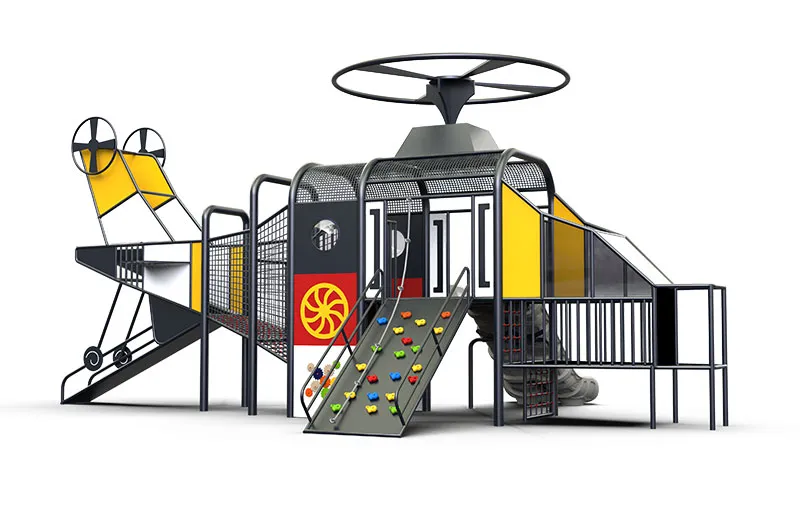
When playground equipment must survive years of outdoor exposure without losing safety or appeal, the manufacturing process and quality control make the difference. Ningke (Wenzhou Ningke Amusement Equipment Co., Ltd.) manufactures commercial‑grade Outdoor Play Equipment, including the Jet Adventure Playground series designed for parks, schools, and commercial facilities. Their equipment uses national standard galvanized steel pipes with 2–3mm wall thickness, LLDPE rotomolded components with UV stabilization, and meets ASTM, EN1176, and TUV certifications. With an annual production capacity of millions of pieces, Ningke maintains ISO9001 and ISO14001 certifications and offers a 2‑year limited warranty against defects. Their team provides design consultation, 3D renderings, professional installation services, and ongoing technical support.
→ Request a quote from Ningke for the Jet Adventure Playground outdoor play equipment — Share your available square footage, target age range (recommended 2–12 years), preferred theme (aviation, adventure, or custom), and budget. Their design team will provide 2D layout plans and 3D concept designs based on your specific space constraints.
 15+ years crafting play
 SGS | EN1176 | ASTM
 40+ countries


 English
 Español
-1507.webp)
.jpg)
.jpg)
.jpg)